
CREATIVE BLOCK? TRY THIS !
A QUICK WAY TO FIND YOUR FLOW AGAIN

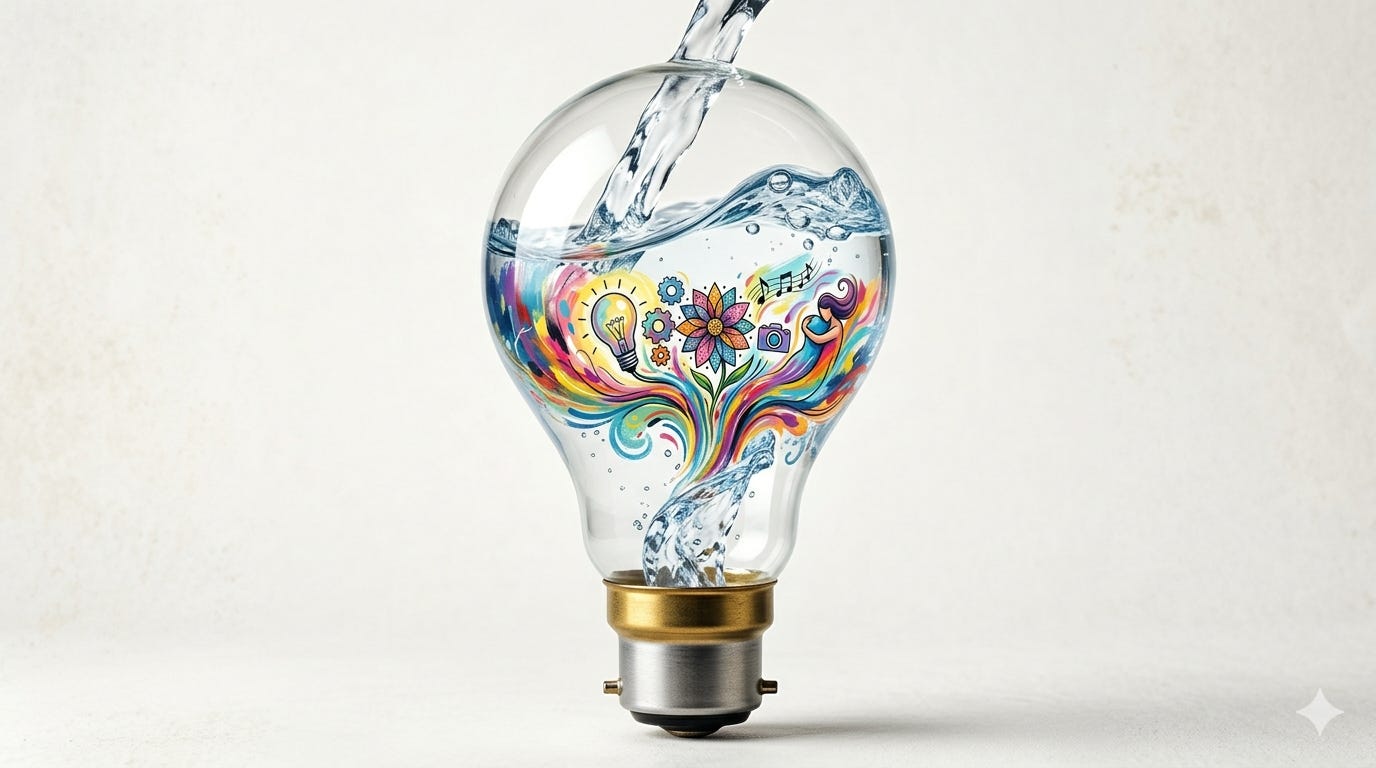
Most creative block is not a lack of ideas.
It is self-surveillance.
Anxiety creates an internal audience before the work even exists. Suddenly every sentence is judged before it is written. Every sketch is evaluated before it is explored. The mind stops producing because it shifts from making to protecting.
This is why many intelligent creatives become inconsistent. Not because they lost talent. Because they became hyper-aware of consequence.
One exercise has helped me more than productivity systems, dopamine hacks, or motivational rituals.
I call it: the ugly sprint.
Set a timer for 20 minutes.
Your only objective is to produce something intentionally bad.
Not mediocre. Bad.
Write the obvious headline.
Draw the cliché composition.
Use the first thought.
Make the thing you would normally reject.
The important part is psychological. You are interrupting perfectionism through controlled permission. You are teaching the nervous system that creation is not danger.
Most anxiety around creative work comes from identity attachment. The work stops being experimentation and becomes evidence. Evidence of intelligence. Taste. Relevance. Talent. Status.
That pressure suffocates play.
But creativity has always depended on play.
Children create constantly because they are not curating themselves. Avant-garde artists understood this too. The Dadaists treated nonsense as liberation. John Cage treated silence as composition. Duchamp treated provocation as a way to bypass institutional expectations. They were not searching for polished outcomes first. They were dismantling fear.
The ugly sprint works because it removes the fantasy of mastery.
And strangely, once the pressure disappears, quality returns.
Not immediately. But naturally.
Halfway through the exercise, the mind often relaxes. The nervous system realizes nobody is watching. The hand moves faster than judgment. Momentum replaces hesitation.
This is usually where the real work begins.
The modern creative industry romanticizes discipline but ignores emotional architecture. Many blocks are not intellectual problems. They are physiological ones. The body feels threatened, so the imagination contracts.
You do not think your way out of that.
You move your way out.
Creativity is less like a performance and more like opening a valve.
The goal is not brilliance.
The goal is flow.
Brilliance tends to arrive afterward.